



What actually counts as an operating expense? How much should you compensate yourself? And do you need any additional Profit First accounts for your specific industry? This guide answers each question—and shows you the fastest way to stand the accounts up.
Getting this right matters. Only 46% of small employer firms were profitable in 2024, while 35% broke even and 19% operated at a loss, according to the Federal Reserve's 2025 Report on Employer Firms. Profit First changes that math by making profit the first thing you set aside instead of the last. As Certified Profit First Professional Rocky Lalvani puts it, the idea is to "give every dollar a job before it gets spent on the wrong thing."
The cornerstone of a successful Profit First setup for your business is setting up the right accounts. These accounts allow you to separate your money for different purposes and see at a glance how much you have on hand to run each area of your business (and which areas may need a little more money contributed towards them).
But what are the accounts? And does your business need more than these five?
The five main Profit First accounts
There are typically five main accounts you use as a business choosing the Profit First method. Having the five accounts makes it easier to prioritize profit by giving you a clear picture of what you have available for each area of your business.
But why do you need so many accounts?
The five Profit First accounts make it easier to approach accounting in a new way. Think of it this way: your typical accounting method usually looks like this:
Sales - expenses = profit
In other words, whatever you have left over after covering all of your expenses is what you keep as profit. But using the Profit First method and Profit First accounts means you're flipping the script, and tackling accounting like this:
Sales - profit = expenses
Your profit goes directly into your profit account first, and whatever is left over is what you have to run every other aspect of your business.
So what five accounts are you starting with? Let's break down the five accounts, how much goes into each, and what they should be used for.
(These aren't in any particular order. Each of the five accounts has an important role, and they work together to make Profit First work.)
How do you determine how much money you should put into each Profit First account?
Determining the exact percentages can be tricky. Every business is different and has unique needs, but there are ranges you can look to as a starting point for what to put into each account.
Mike Michalowicz, who created the Profit First method, publishes a grid of Target Allocation Percentages (TAPs) based on your Real Revenue—your total income minus the cost of materials and subcontractors. Here's the standard starting grid from his official Instant Assessment:
Account | $0–250K | $250K–500K | $500K–1M | $1M–5M | $5M–10M | $10M–50M |
|---|---|---|---|---|---|---|
Profit | 5% | 10% | 15% | 10% | 15% | 20% |
Owner's Pay | 50% | 35% | 20% | 10% | 5% | 0% |
Tax | 15% | 15% | 15% | 15% | 15% | 15% |
Operating Expenses | 30% | 40% | 50% | 65% | 65% | 65% |
Read each column top to bottom: it shows what share of every dollar of Real Revenue goes to each account at your revenue level. Owner's Pay shrinks as you scale and hire a team, which is why the Profit and Operating Expenses shares shift with it. Treat these as starting targets, not fixed rules—move toward them gradually rather than overhauling your allocations overnight.
Let's look at each account in depth.
1. Income account
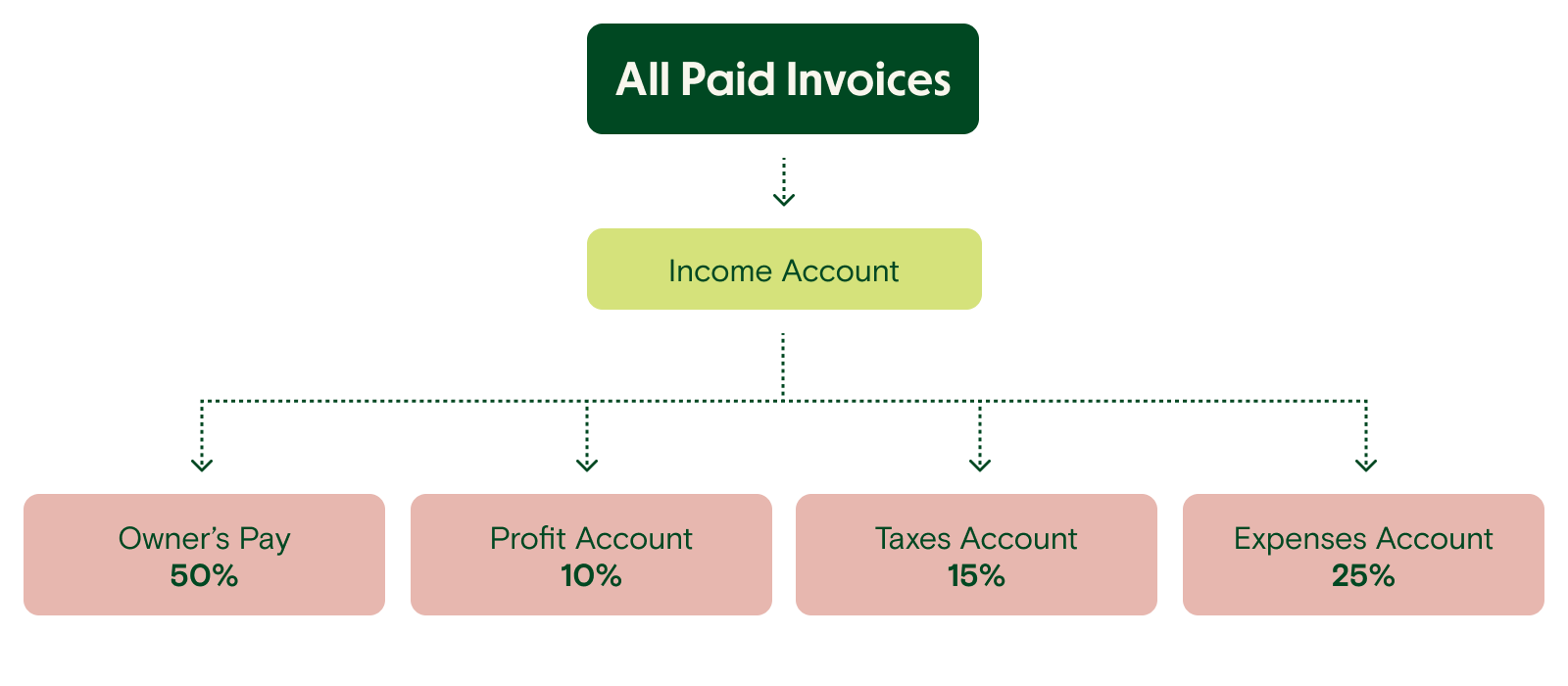
Think of your income account as a holding tank where all of your money will initially start. Everything in your business will go into the income account—sales, wire transfers, check deposits, and any other way money comes in.
It's from here that you will start to divide up your money into the other accounts, based on the percentages you establish.
If you're more of a visual learner, check out the visual below that shows you how your income account works (and remember, the percentages shown here are just an example—your ideal allocations may be different!).
2. Profit account
5-20% of your income
The name may be a giveaway, but this account is where you are going to put your profit.
The money you put into this account has to go here before any other expense is paid out, and should be set aside completely and not touched (unless you're reinvesting in the business or participating in profit distribution with your team).
3. Owner's pay
5-50% of your income
It can be hard to fairly compensate yourself as a business owner. There are so many other areas that pull money in your business, and you may be tempted to give yourself less of a salary to keep the business running and growing.
With Profit First, you allocate a percentage of your income for your salary, and that amount goes into a dedicated owner's pay account automatically.
If you're struggling with what to pay yourself, ask yourself this: What would somebody doing your role somewhere else make? That gives you a great and objective idea of what you need to be putting aside into your owner's pay account.
If you aren't paying yourself fairly, enough, or at all, you're going to grow resentful of your business. And that's going to make it hard to want to put the work in.
4. Tax account
15% of your income
Tax season is stressful when you're scrambling to pull together a large payment at the deadline. Searching through pockets for receipts, countless hours with your accountant or bookkeeper, trying to find a large chunk of money to settle up—it's a headache. But your Profit First tax account ensures you'll at least have enough to cover the bill when the time comes.
This account is where you safely put aside money for your taxes. Michalowicz's standard starting allocation is 15% of Real Revenue (he suggests 15–20% depending on your entity type and location). When tax season comes around, you'll be ready to face it head-on.
5. Operating expenses
30-65% of your income
Your operating expenses—or OpEx—account covers the money it takes to actually run your business. Anything that's leftover after your other allocations are deposited into the above accounts goes towards your OpEx. This is the money you have left to run your business—rent, supplies, payroll, and everything in between.
We'll be honest: it's going to be uncomfortable to operate this way at first. Many businesses wait to see what's left over after their operating expenses, and use that to deal with everything else outlined above. But when you distribute your money into accounts like this, you become more disciplined with your spending and shift into a profit-focused mindset.
It's also important to note that the percentage ranges for the Profit First accounts above don't add up to 100% if you use the maximum of each range. To increase the percentage you put into operating expenses, for example, you need to decrease the percentage going into owner's pay. You need your percentage allocations to add up to 100%.
Are there any additional Profit First accounts?
The key to Profit First is using these five Profit First accounts, but the beauty of Profit First—outside of watching your profit grow—is that you can tailor it to your specific business needs.
Here are some examples of additional Profit First accounts that you may want to add.
Materials/Inventory: This account is great for businesses that spend a large part of their operating expenses on inventory or materials. Think construction, where you can spend tens of thousands of dollars a month on raw supplies. In these cases, it may be helpful to have a separate account.
Marketing: So many agencies are using Profit First. Separate accounts that pull money for marketing spend for clients can be hugely helpful for keeping the money clients send you organized, especially if you're dealing with numerous clients.
Payroll: Payroll is typically a large chunk of any business's operating expenses. Depending on your setup or workforce, having a separate payroll account can help you stay organized.
COGS: E-commerce or other product-based businesses need to have cash set aside to manufacture or purchase the goods they sell. As e-commerce and product-based businesses scale, having an account dedicated to COGS can help you see exactly how much is going towards this area of your business.
A Vault account is another common addition—a long-term hold for profit and emergency reserves, kept separate from the profit account you distribute from quarterly.
Remember, the additional accounts aren't mandatory. It's meant to be what works for you. If having additional accounts and division helps you, great. If keeping it simple with the initial five accounts is best for you, that's great too.
How do you set up Profit First accounts?
Setting up doesn't have to be tricky. Here are the steps for setting up your Profit First accounts.
1. Work with your bank or banking platform to set up your Profit First accounts. You'll need at least five accounts set up to use this method effectively.
Pro tip: Traditional banks may tie up your cash flow by making you hold a minimum balance to avoid fees. Work with low-cost banking platforms like Relay for the easiest way to set up multiple accounts without paying to keep each one open.
2. Determine your Profit First percentages. This will determine what percentage of the cash that lands in the Income account goes to each of the other accounts.
3. Set an allocation schedule. This can be every payday, the first and last day of each month, or whatever works for you. This date is when you will allocate the money to each of your separate Profit First accounts.
4. Now, run your business based on the funds in your OpEx account. By using your expense account only, you know your business is running at a profit. Even if it's just a dollar, having that money in your profit account is a huge win.
Easily implement Profit First with Relay
There are plenty of reasons small business owners use Relay to run Profit First, but here are a few of our favorites:
Up to 20 checking accounts: With no hidden fees or minimum account balances, you can set up deposit-only accounts as well as operating expense accounts, giving you greater clarity into cash flow.
Percentage-based transfers: Make your Profit First transfers easily with Relay's percentage-based transfer feature—and automate them when you're ready, so allocations happen on every deposit without manual work.
Streamline bookkeeping with accounting integrations: Relay's integrations with QuickBooks Online and Xero help you spend less time deciphering transactions and more time growing your business.
Up to 50 physical or virtual Relay Visa® Debit Cards³ that can be assigned spending limits, so you can get a clear picture of where your money is going.
Profit First only works if the buckets are real accounts that fund themselves. Open a Relay account to set up your Income, Profit, Owner's Pay, Tax, and Operating Expenses accounts with automated percentage-based transfers that move money on every deposit.
³The Relay Visa® Debit Card is issued by Thread Bank, Member FDIC, pursuant to a license from Visa U.S.A. Inc. and may be used anywhere Visa debit cards are accepted.
Frequently asked questions
How many bank accounts do I need for Profit First?
You need at least five to run Profit First properly: Income, Profit, Owner's Pay, Tax, and Operating Expenses. Many owners add accounts as they grow—a vault for long-term reserves, or dedicated accounts for materials, payroll, or marketing. Your bank should let you open the accounts you need without charging a monthly fee or minimum balance for each one.
Can I automate Profit First transfers instead of moving money by hand?
Yes. The friction most people hit with Profit First is remembering to move money on every deposit. A banking platform with percentage-based auto-transfers can split each deposit across your accounts automatically the moment revenue lands, so your allocations happen without a manual step. With Relay, percentage-based transfers are available on every plan and can be automated to fire on each deposit.
What percentage should go into each Profit First account?
Michalowicz's starting Target Allocation Percentages depend on your Real Revenue (income minus materials and subcontractors). A business under $250K typically starts near 5% Profit, 50% Owner's Pay, 15% Tax, and 30% Operating Expenses; as revenue grows, Owner's Pay drops and Operating Expenses rises. Use the grid above as a starting point and adjust gradually toward the targets.
BANKING FOR THE SELF-MADE
Get started in minutes.