


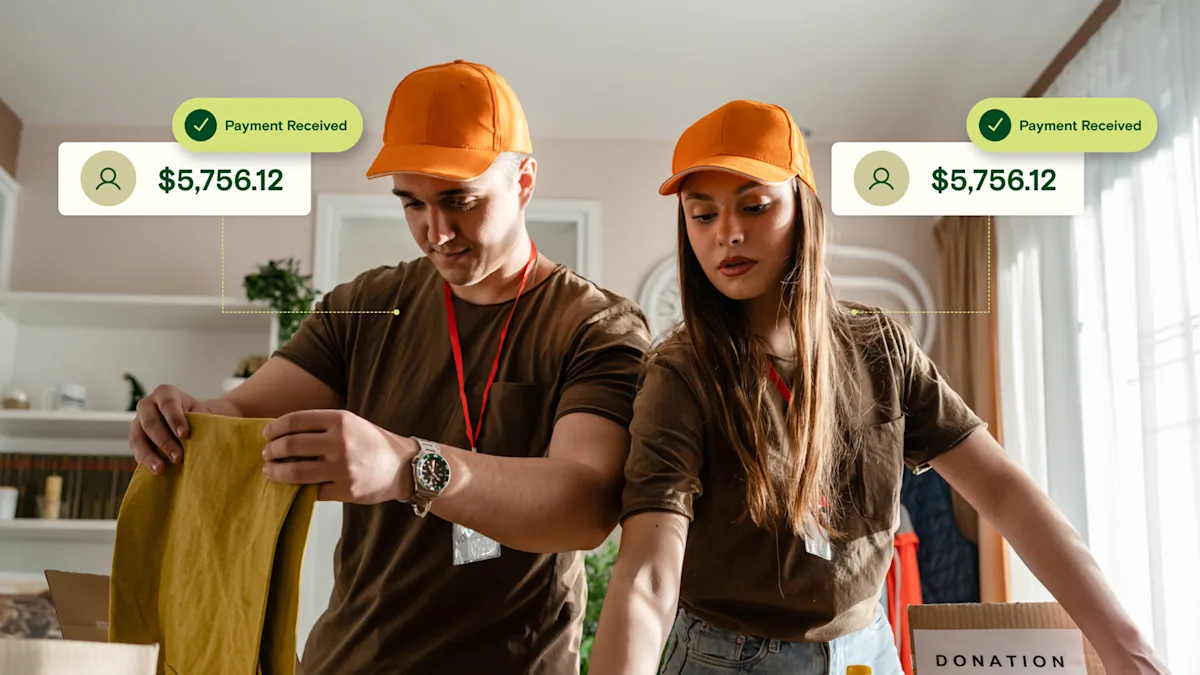
Nonprofits pay employees the same basic way for-profit businesses do—through payroll, with taxes withheld—but a few rules are genuinely different, from which payroll taxes they owe to how they can fund salaries. This guide breaks down exactly how a nonprofit pays its employees.
Nonprofit organizations exist to fulfill a mission rather than to make a profit, so their finances are regulated differently from for-profit companies—and that extends to how they pay employees.
How does a nonprofit pay employees?
Nonprofits pay employees through payroll, just like for-profit businesses. That means a nonprofit needs a business bank account to fund salaries, and it must withhold and remit payroll taxes. Nonprofits may also have to follow certain rules when opening a bank account.
Common misconceptions about how nonprofits pay employees
❌ All nonprofit staff members are volunteers.
✅ Nonprofits not only have but depend on paid employees to operate.
❌ Employee salaries only come from donations.
✅ Salaries can come from donations, grants, program fees, or other income-generating activities.
❌ Nonprofits don't pay any payroll taxes.
✅ Nonprofits are exempt from federal unemployment tax but still withhold income tax and pay Social Security and Medicare.
Let's take a closer look at each.
Why nonprofits need volunteers AND employees
Volunteers play an important role in nonprofits—many board members are unpaid volunteers. But nonprofits need paid employees too:
Reliability and consistency: Paid staff provide consistency that's hard to achieve with volunteers alone.
Expertise: Nonprofits need professionals with specific qualifications to manage complex programs, handle finances, or lead strategy.
Accountability and commitment: Employees carry a higher level of accountability for ongoing programs.
Long-term sustainability: Paid staff contribute the organizational stability required for long-term planning and community impact.
Similarities in how nonprofits and for-profits pay employees
Nonprofit workers may earn less than private-sector peers because of limited funds, but both nonprofit and for-profit organizations must follow the Department of Labor's Fair Labor Standards Act (FLSA): federal and state minimum wage, overtime pay, and worker classification. Employees can be full-time or part-time, hourly or salaried. Both types of organization can offer benefits like health insurance and retirement plans, and both follow payroll tax rules—with some important distinctions covered below.
How nonprofit employees are classified
Here are common federal rules nonprofits must follow (state laws may add more):
All employees must earn at least the federal minimum wage, currently $7.25 per hour. States like California set higher minimums.
Employers must pay overtime at 1.5× base pay to non-exempt hourly employees who work over 40 hours in a week. At $20/hour base, overtime is $30/hour.
The Department of Labor sets requirements for classifying employees as exempt (salaried), including job duties and a minimum salary threshold.
One nonprofit-specific FLSA nuance: a paid employee can't also "volunteer" to do the same type of work they're paid for. True volunteers—serving for public or humanitarian reasons, with no expectation of pay and not displacing paid staff—aren't employees (DOL Fact Sheet #14A). Consult an HR expert for classification questions.
Do nonprofit employees receive paid benefits?
While nonprofits often can't match private-sector salaries, they do offer benefits:
Competitive healthcare and retirement plans
Flexible work schedules
More vacation time
Tuition reimbursement and/or student loan forgiveness
The reward of making a difference
On retirement specifically, 501(c)(3) organizations can sponsor a 403(b) plan—a tax-sheltered annuity option generally available only to 501(c)(3)s and public schools, subject to a universal-availability rule (IRS 403(b) plans). These perks aren't a substitute for fair pay; a fair salary keeps employees around longer.
Funding sources for paying nonprofit employees
Every year, nonprofits build a budget of expenses (program costs, salaries) and income (funding). Payroll can be funded from:
Donations: money, goods, or services from individual donors.
Grants: funds from government or institutions for a specific purpose.
Income-generating activities: paid speaking, consulting, or product sales that generate income independently of donations and grants.
Nonprofits often receive restricted funding that can only be used for specific programs or purposes. Sometimes that purpose is payroll, but often it isn't—and restricted funds must only be used as intended.
Juggling multiple revenue streams and expense categories is hard. With Relay, nonprofits can open up to 20 individual checking accounts with no monthly maintenance fees, organize money across accounts, and get total visibility into cash flow. If your nonprofit receives restricted funding earmarked for payroll, you can open a dedicated payroll bank account so you never accidentally spend restricted funds.
What payroll taxes do nonprofits actually pay?
Tax-exempt status does not mean payroll-tax-exempt. A 501(c)(3) with employees must withhold federal income tax and the employee share of FICA, and pay the employer share of FICA, just like a for-profit (IRS). FICA is Social Security at 6.2% from the employer and 6.2% from the employee (up to the annual wage base of $176,100 in 2025 and $184,500 in 2026), plus Medicare at 1.45% each with no wage cap (SSA). Employees earning cash wages are still subject to these taxes.
The big exemption: 501(c)(3) organizations are exempt from federal unemployment tax (FUTA) under IRC §3306(c)(8), and the exemption is automatic and can't be waived (IRS).
The reimbursable method for state unemployment
State unemployment tax (SUTA) is different. Federal law requires states to give 501(c)(3)s a choice: pay regular SUTA payroll tax like any employer, or elect the "reimbursable method"—reimbursing the state dollar-for-dollar for the actual unemployment benefits paid to their former employees (DOL/ETA). The reimbursable method can save money for nonprofits with low turnover, but exposes you to a large bill if several employees claim benefits at once. It's a state-administered election, so the enrollment and exact mechanics vary by state—check with your state's unemployment agency.
Reasonable compensation and other regulations
Nonprofits must follow rules to keep their tax-exempt status:
Leadership salaries (like an executive director's) must be reasonable compensation—excess-benefit transactions to insiders can trigger intermediate-sanctions excise taxes.
A 21% excise tax applies to remuneration over $1,000,000 paid to a covered employee of a tax-exempt organization (IRC §4960). The 2025 One Big Beautiful Bill Act broadened who counts as a covered employee, with IRS regulations still pending (IRS).
Executive compensation must be reported transparently on the IRS Form 990.
Restricted funds can only be used for their intended purpose.
Can nonprofit founders and board members be paid a salary?
Yes. A nonprofit founder, officer, or director can be paid a salary for bona fide services, as long as the pay is reasonable for the role and the work. Because founders and officers are typically "disqualified persons" under the IRS intermediate-sanctions rules (§4958), the safest practice is to have an independent board approve the compensation and document the decision—ideally benchmarked against comparable organizations. That establishes a rebuttable presumption that the pay is reasonable (IRS). What a founder can't do is set their own pay unilaterally or draw compensation that isn't tied to real services.
Relay: paying your employees, made easier
There are a lot of nuances to how nonprofits pay employees, from classifications to which taxes apply. The right banking platform makes it easier.
Relay is an online banking and money management platform that gives nonprofits total visibility into income and expenses, including salaries. A few reasons nonprofits bank with Relay:
✅ Open up to 20 individual checking accounts: set aside grants, budget for operating expenses, and separate restricted funds.
✅ No monthly maintenance fees, no overdraft fees, no minimum balances: avoid unnecessary costs.
✅ Entirely online banking: open accounts, issue cards, and send and receive payments online—no branch visits.
✅ Up to 50 Relay Visa® Debit Cards³: issue cards for specific projects and expenses, with instant virtual cards for online payments.
✅ Built for teams: set card spending limits, see detailed spend data, and invite your accountant or assistant with role-based logins.
✅ Streamlined bookkeeping: sync detailed banking data into QuickBooks Online or Xero.
Before you commit payroll funds to one bank, our roundup of the best business bank accounts for nonprofits breaks down other providers worth reviewing. If you're ready, open a Relay account—it takes about ten minutes to apply.
3The Relay Visa® Debit Card is issued by Thread Bank, Member FDIC, pursuant to a license from Visa U.S.A. Inc. and may be used anywhere Visa debit cards are accepted.
Frequently asked questions
Can a 501(c)(3) pay its employees?
Yes. A 501(c)(3) pays employees through payroll like any employer, funding salaries from donations, grants, program fees, or earned income. It withholds federal income tax and the employee share of Social Security and Medicare, and pays the employer share.
Do nonprofits pay payroll taxes?
Partly. Nonprofits withhold income tax and pay Social Security (6.2% each side, up to $176,100 in 2025 / $184,500 in 2026) and Medicare (1.45% each). They're exempt from federal unemployment tax (FUTA) as 501(c)(3)s, and can elect a reimbursable method for state unemployment tax in most states.
Can a nonprofit founder pay themselves a salary?
Yes, for bona fide services at reasonable compensation. Because a founder is usually a "disqualified person" under IRS rules, an independent board should approve and document the pay to avoid excess-benefit excise taxes.
Where does the money to pay nonprofit employees come from?
From donations, grants, program or service fees, and other income-generating activities. Some funding is restricted to specific programs and can't be used for payroll, so nonprofits track restricted and unrestricted funds separately.
BANKING FOR THE SELF-MADE
Get started in minutes.