



Small business owners entered the year feeling optimistic. In a Relay survey of more than 1,000 U.S. small business owners, 94% said they expected their business to grow, and nearly a third were targeting revenue gains of 20% or more.
Then you look at the bank balance.
More than half of those same owners had less than 31 days of operating expenses on hand. Three in four said cash flow problems had hurt their business the year before. The optimism was real—but so was the distance between growing revenue and having money owners could actually count on.
The data below comes from that survey. It maps where cash flow breaks down for small businesses, what those breakdowns cost, and what the owners who stay stable do differently.
Key findings
94% of owners expected to grow when surveyed; nearly a third were targeting revenue gains of 20% or more.
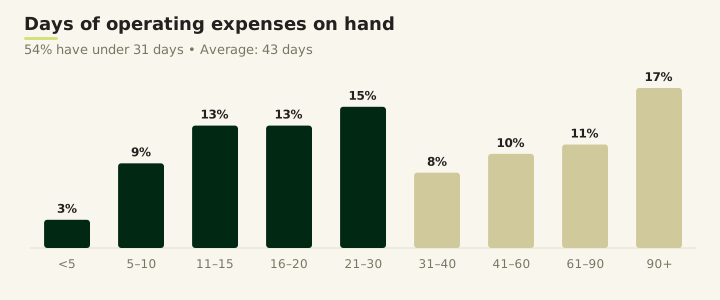
54% have less than 31 days of operating expenses in reserve; the average runway is 43 days.
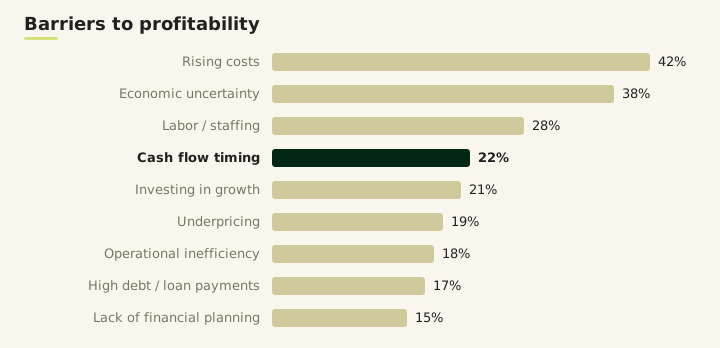
82% say their business is profitable—but 94% report barriers to profitability, led by rising costs and economic uncertainty.
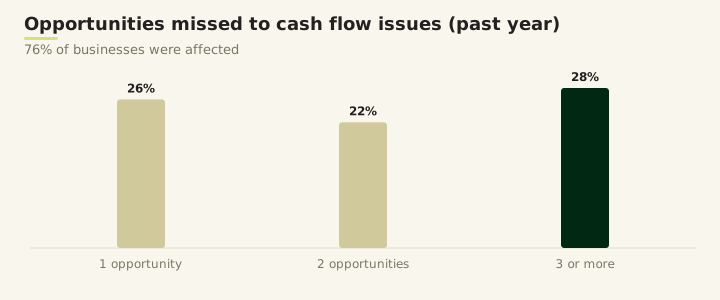
76% say cash flow problems hurt their business in the past year; 88% were hit by an unexpected cash flow issue.
95% felt confident managing cash flow, yet only 31% were actively optimizing it and just 43% had reserves for recent disruptions.
86% have seen the cost of doing business rise, by an average of nearly 11%.
64% would trust AI to help manage their cash flow, and roughly one in three already use AI tools to do it.
Nearly every owner expected to grow. Few planned for the cash it takes.
94% of owners said they expected to grow, and nearly a third were aiming for revenue gains of 20% or more. Most pointed to their existing base as the engine: loyal repeat customers topped the list of expected growth drivers.
Where owners expect growth to come from | Share |
|---|---|
Loyal repeat customers | 49% |
Sales, marketing, or business development | 41% |
Expansion into new segments or markets | 38% |
Launching new products, services, or locations | 36% |
Technology improvements | 35% |
Team expansion | 33% |
New partnerships | 32% |
Among owners expecting growth (n = 933).
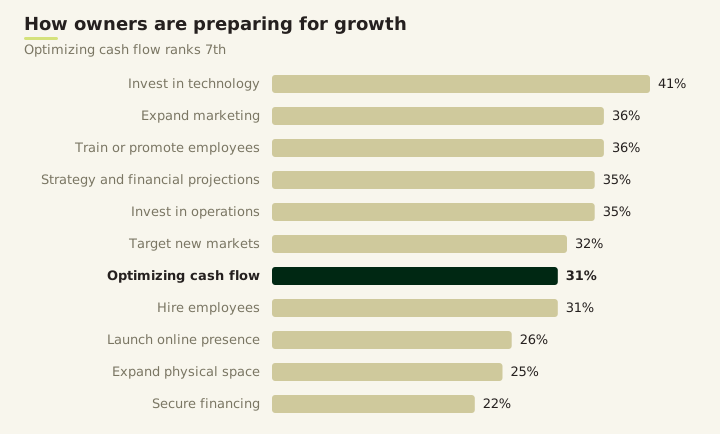
Owners were backing that optimism with real moves: investing in technology, expanding marketing, hiring and training staff. But one thing didn't make the top of the list. Even though 88% had been hit by an unexpected cash flow issue in the past year, optimizing cash flow ranked seventh among the steps they were taking to prepare for growth.
Step taken to prepare for growth | Share |
|---|---|
Invest in technology | 41% |
Expand marketing | 36% |
Train or promote employees | 36% |
Strategy and financial projections | 35% |
Invest in operations | 35% |
Target new markets or geographies | 32% |
Optimizing cash flow | 31% |
Hire one or more employees | 31% |
Launch or relaunch online presence | 26% |
Expand physical space | 25% |
Secure financing | 22% |
Among owners expecting growth (n = 936).
That's a costly blind spot, because growth is what strains cash flow in the first place. More customers means more invoices outstanding, more inventory to float, more payroll to make before the money lands.
"The mistake is thinking growth will solve the problems. In reality, growth amplifies them," says Mike Michalowicz, author of Profit First. "As an organization sells more, it triggers more obligation and more variability. Most business owners don't need to add more—they need to subtract. Reduce variability. Build consistency. The first fix is profitability. The second is clarity."
More than half of small businesses have less than a month of runway
54% of owners have less than 31 days of operating expenses on hand. Across all businesses, the average runway is 43 days—but that average hides how many are living close to the edge.
Days of operating expenses on hand | Share |
|---|---|
Less than 5 days | 3% |
5–10 days | 9% |
11–15 days | 13% |
16–20 days | 13% |
21–30 days | 15% |
Under 31 days (subtotal) | 54% |
31–40 days | 8% |
41–60 days | 10% |
61–90 days | 11% |
More than 90 days | 17% |
Average | 43 days |
n = 984.
That's a thin margin for a plan built on growth. A single delayed invoice, a surprise repair, or a slow month can turn into a scramble for a short-term loan. Runway is what converts a bad week into a manageable one instead of an emergency—and most owners are operating with very little of it.
Most are profitable. Almost all face barriers to staying that way.
82% of owners say their business is profitable, and 77% are satisfied with their margins. That's the good news. The catch: 94% also report barriers to profitability.
Barrier to consistent profitability | Share |
|---|---|
Rising costs (supplies, rent, utilities) | 42% |
Economic uncertainty | 38% |
Labor costs or staffing challenges | 28% |
Cash flow timing (late payments, uneven income) | 22% |
Investing heavily in growth | 21% |
Underpricing products or services | 19% |
Operational inefficiencies or waste | 18% |
High debt or loan repayments | 17% |
Lack of financial planning or forecasting | 15% |
n = 983.
Profit on paper and cash in hand aren't the same thing. Margins can be real while the money sits in limbo—waiting to be collected, earmarked for taxes, or already spoken for by payroll. That's why owners who look profitable can still find themselves short, and why visibility into where the money actually is matters as much as the margin itself.
Cash flow problems don't just sting. They cost opportunities.
76% of owners say cash flow issues hurt their business in the past year—and for most, it happened more than once. 28% say cash flow problems cost them three or more opportunities over the year.
Opportunities missed to cash flow issues | Share |
|---|---|
One | 26% |
Two | 22% |
Three or more | 28% |
The damage wasn't just stress. It showed up in lost growth, stalled work, and, for some, second thoughts about the business itself.
Consequence of cash flow issues | Share |
|---|---|
Missed growth opportunities | 25% |
Delayed or cancelled projects | 19% |
Lost customers or clients | 19% |
Reduced employee hours or shifts | 17% |
Considered quitting or ending the business | 15% |
Reduced customer experience | 15% |
Downsizing or layoffs | 14% |
Reduced or suspended employee benefits | 14% |
n = 985.
That's not bad luck. That's a pattern.
Owners felt in control. The numbers said otherwise.
95% of owners said they felt confident managing cash flow. Only 31% were actively optimizing it, and just 43% had enough in reserve to cover recent disruptions.
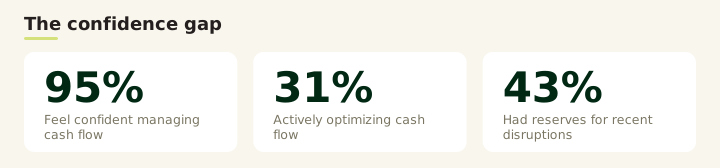
Confidence without control is the real risk. A lot of owners run their finances on instinct—patching things in real time and hoping it holds. It feels like a system right up until a payment doesn't land, and the system turns out to be a spreadsheet and a gut feeling.
Control doesn't require doing everything perfectly. It comes from simple, repeatable habits that build clarity over time.
"Most small businesses fail because of poor cash flow management, but owners who review their financial statements weekly have a much higher success rate," says Gretchen Roberts, CEO of Red Bike Advisors. "Review your profit and loss, balance sheet, and cash flow statement every week. Within a year, you'll be spotting patterns and making smarter decisions. And if you're not sure where to start? Just start."
Costs keep climbing, and owners are absorbing the hit
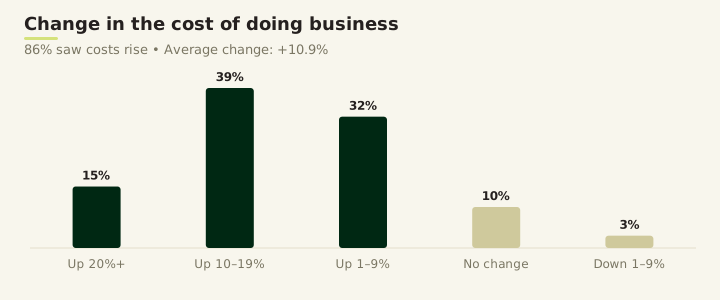
86% of owners have seen the cost of doing business rise, by an average of nearly 11%. More than half report a moderate-to-significant jump.
Change in cost of doing business | Share |
|---|---|
Significant increase (20%+) | 15% |
Moderate increase (10–19%) | 39% |
Slight increase (1–9%) | 32% |
Any increase (subtotal) | 86% |
No change | 10% |
Slight decrease | 3% |
Average change | +10.9% |
n = 985.
When owners look at what's squeezing them, the pressures are broad—but a few dominate.
Economic factor most impacting the business | Share |
|---|---|
Inflation and rising costs | 60% |
Government or trade policy actions | 36% |
Consumer spending behavior | 34% |
Interest rates and financing | 33% |
Supply chain disruptions | 30% |
Energy and utility costs | 29% |
Labor shortages and talent retention | 25% |
n = 990.
Owners respond by raising prices (43%) and changing suppliers (31%). And when a surprise triggers a cash flow crunch, it tends to come from a few familiar places: supply chain disruptions (29%), unexpected fees (27%), and interest rates (23%). With fewer than half holding enough in reserve, most get scrappy—tightening spending (27%), negotiating payment terms (18%), or borrowing to cover the gap (12%).
"When things keep shifting, you pull back. You start making only short-term, reactionary choices. That's the real cost—it suppresses action," says Michalowicz. "The solution is to focus on what's certain, even if it's not ideal. Once you know what you're dealing with, you can build a plan and move forward."
Most owners are ready to hand cash flow to AI
64% of owners say they'd trust AI to help manage their cash flow, and roughly one in three already use AI tools to do it. The tasks they most want help with are the tedious, error-prone ones:
Task owners want AI to handle | Share |
|---|---|
Automatically tracking income and expenses | 48% |
Automating billing and payments | 46% |
Predicting future cash flow | 39% |
Not everyone is sold. 22% are undecided and 14% wouldn't trust AI with their cash flow at all. But the appetite is clear: owners want the repetitive parts of money management handled automatically, so their attention goes to the decisions that actually need a human.
The squeeze looks different depending on what you do
Cash flow stress is nearly universal, but where it lands depends on the business:
Real estate owners report the longest average runway—55 days, versus 43 for small businesses overall—and they're the most optimistic about the economy. More than half point to new partnerships as their biggest growth driver.
Skilled trades feel the cost squeeze hardest: 47% cite rising material costs as a barrier to profitability. They're also the least prepared to hand off the business—only 26% have someone ready to step in.
Retail and ecommerce feel it in the supply chain, where one in three report disruptions. They're also the most open to automation: two-thirds would trust AI with their financial management, more than any other sector.
Everyone's fighting the same economy. Not everyone's getting hit in the same place.
Behind most small businesses is a family
Small businesses may have one name on the paperwork, but the support system runs deeper:
80% of owners say family members support the business as customers.
64% say family members work in the business.
73% have someone who could take over if they stepped away.
That safety net isn't fully secured, though. Nearly one in five owners say their would-be successor would need serious training before they could step in. The business runs on family, but the handoff still takes a plan.
What the most resilient businesses do differently
The businesses that stay stable through rising costs and surprise expenses aren't necessarily the biggest or the most profitable. They're the ones with structure. A few habits show up again and again.
They separate their money. Instead of running everything from one balance, resilient owners give each dollar a job—operating expenses, payroll, taxes, profit—in dedicated accounts. Relay is built around this, letting owners open multiple checking accounts so the money for taxes isn't sitting in the same pool as the money for payroll.
They set profit and taxes aside first. Rather than waiting to see what's left at month's end, they carve out reserves up front. Automatic transfers that move a set percentage of every deposit into profit, tax, and reserve accounts turn that from a discipline problem into a default.
They watch the numbers before the books close. Real-time visibility into what's been spent and what's coming means fewer surprises. When transactions are categorized as they happen, owners spot a problem in week two instead of finding out at month-end.
They get help. Resilient owners know when to bring in a bookkeeper, a fractional CFO, or a Profit First professional—and how to give an advisor secure access to the numbers without handing over the keys.
None of this happens overnight. It builds one habit at a time. But it's what separates the businesses that absorb a bad month from the ones a bad month takes down.
Frequently asked questions
How many days of cash reserve does the average small business have?
About 43 days on average, but 54% of small businesses have less than 31 days of operating expenses on hand.
What percentage of small businesses expect to grow?
When surveyed, 94% of owners expected their business to grow, and nearly a third were targeting revenue gains of 20% or more.
Are most small businesses profitable?
Yes—82% of owners report that their business is profitable and 77% are satisfied with their margins. But 94% also cite barriers to profitability, led by rising costs (42%), economic uncertainty (38%), and staffing challenges (28%).
How common are cash flow problems for small businesses?
Very. 76% of owners say cash flow issues hurt their business in the past year, and 88% were hit by an unexpected cash flow issue.
Do small business owners trust AI to manage cash flow?
64% say they'd trust AI to help manage their cash flow, and roughly one in three already use AI tools for tasks like tracking expenses, automating payments, and forecasting.
What do the most resilient small businesses do differently?
They separate funds by purpose, set aside profit and taxes before spending, review their numbers weekly, and bring in expert help when they need it.
About this data
The findings come from a Relay survey of more than 1,000 U.S. small business owners, fielded in early 2025, spanning a range of industries, regions, revenue levels, and team sizes.
Respondent profile | Largest segments |
|---|---|
Region | South 44%, Northeast 20%, Midwest 19%, West 18% |
Annual revenue | $1M+ 54%; $240K–$1M 46% |
Team size | 20+ employees 59%; 2–20 employees 41% |
Top industries | Skilled trades 21%, business & professional services 15%, technology 13%, financial 12% |
n = 1,004.
Relay is a business banking platform built to help small business owners take control of their cash flow. See how Relay helps you organize your money by purpose.