


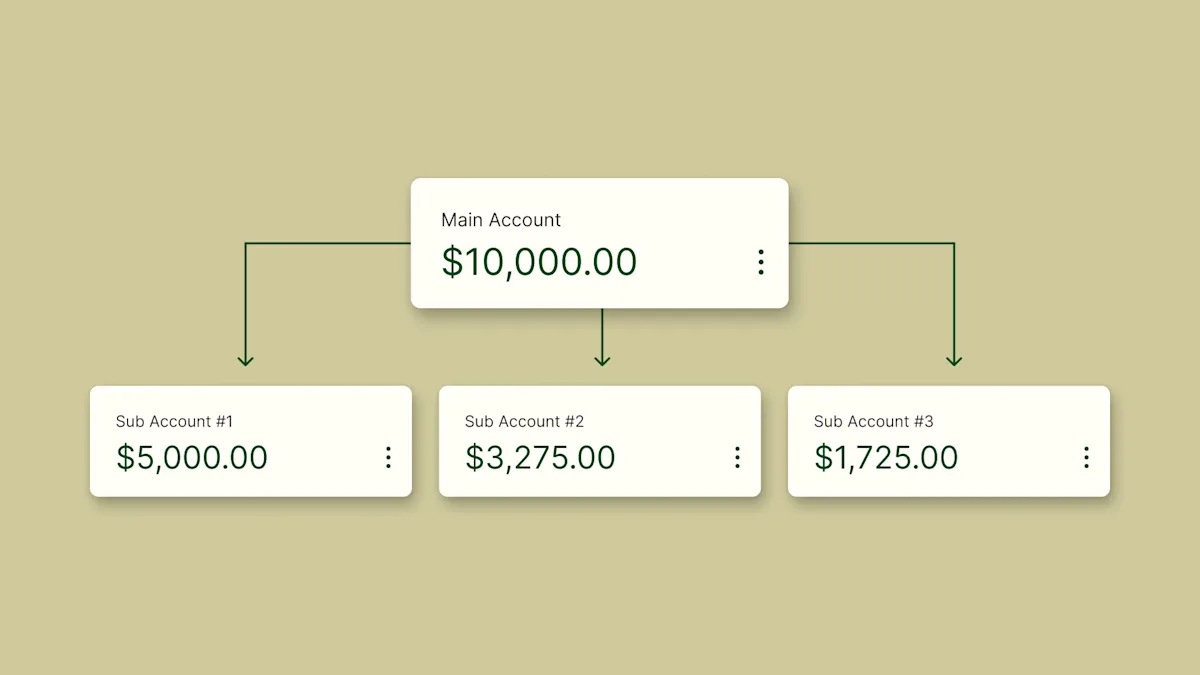
A sub-account is a bank account that exists inside another bank account—a way to split one business checking account into separate compartments for income, expenses, taxes, and more. When all your money sits in a single account, you get a long list of transactions but no real insight into where it's going. Sub-accounts fix that by compartmentalizing your money, so you can see at a glance what's earmarked for what.
What is a sub-account?
Like the name suggests, a sub-account is a bank account that exists within another bank account. If you imagine your business bank as a filing cabinet, the first drawer is your main business checking account, and each folder within that drawer is a sub-account.
Sub-accounts give you greater clarity into cash flow because they help compartmentalize your money.
Picture it: if you only have one main operating account, you're used to signing in and seeing a long list of transactions. Has your client settled an invoice? Have bills already been paid? How much do you have earmarked for bills? It's unclear at first glance—you have to dig into the expenditures to answer.
With sub-accounts, you get more clarity immediately. If you have an income account and an expense account, the income account shows how much your business is earning and the expense account shows how much it's spending. You get a much clearer view of where every dollar is allocated and spent.
When picking a business bank, it's essential to choose one that lets you create new sub-accounts, so your business can implement frameworks like the digital envelope system or multiple bank account budgeting.
Which banks offer sub-accounts?
Many neobanks and online financial institutions offer multiple sub-checking accounts at no monthly cost, so it's worth asking about this when choosing a business bank account. With Relay, you can open up to 20 individual checking accounts, which work like sub-accounts (more on this below).
Sub-account vs savings account: what's the difference?
A savings account is a specific type of account meant to hold money you're not spending, often earning interest. A sub-account is a structural idea—a compartment inside a larger account—and it can be a checking sub-account or a savings sub-account. In other words, "savings account" describes what the account is for, while "sub-account" describes how it's nested. You might keep several checking sub-accounts for operating categories and a separate savings sub-account for your reserve. Choose the account types based on your goals: checking for money that moves, savings for money you're setting aside.
Advantages of sub-accounts
Sub-accounts are a great way for small business owners to separate funds for different expenses, so you can better organize, budget, and see how money flows in and out of your business.
Some advantages of using sub-accounts:
Visually separate your money by category for better visibility into your finances
Clearly see how each dollar is being allocated in your business
Easily move funds between accounts within one banking dashboard
Speed up bookkeeping, since your expense categories are already set up in your bank
Earmark for taxes from the start with a dedicated tax sub-account
How to organize finances with sub-accounts
Sub-accounts can be used in a variety of ways depending on your business's needs. The possibilities are nearly endless, but here are three scenarios.
Scenario 1: sub-accounts by expense category
The most common setup is by expense type: you categorize your business expenses and create a sub-account for each. Here's how a typical small business could set up its accounts:
Primary account
Operating expense account (rent, operating expenses, etc.)
Payroll account
Savings account
Tax account
Travel expense account
Emergency fund
All your money flows through your primary checking account and into your dedicated sub-accounts. Instead of one account with a long list of transactions, you have separate accounts to gauge your spending habits—so you can see exactly how much you can move into savings each month and how much is left for travel or emergencies.
Scenario 2: sub-accounts by department or product vertical
Sometimes it makes sense to organize sub-accounts by department instead of expense type. This works for an e-commerce company with different storefronts or product verticals. Using an online clothing store as an example:
Primary account
Women's clothing account
Men's clothing account
Shoes and accessories account
Revenue from each store flows into the primary account, then filters to the corresponding sub-account so each department has better control over its profits and losses. If you want to determine the most profitable department and how much you can re-invest in each, this setup is a good choice.
Want to level up your e-commerce cash flow management? Learn how to apply Profit First to e-commerce.
Scenario 3: sub-accounts by property (for real estate investors)
If you're a real estate investor, sub-accounts can be a game-changer for managing profitability across your portfolio. If you own several short-term rentals, you can organize sub-accounts by property:
Primary account
Property #1
Property #2
Property #3
Property #4
Property #5
Organizing your multiple checking accounts this way helps you determine which rental property is the biggest earner—which in turn gives you insight when you're ready to grow your portfolio. Agencies and consultants often set up dedicated accounts the same way, splitting funds by category so profitability is easy to see at a glance. You can read more about that setup in Relay's guide to banking for agencies and consultants.
Running Profit First for your properties? Read how to get started with Profit First for real estate investing.
Sub-accounts vs individual checking accounts
After seeing the different ways to use sub-accounts, you may be wondering: why use sub-accounts when I can just open individual checking accounts?
The simple answer: you absolutely can. In fact, we recommend individual checking accounts, because not all sub-accounts are created equal.
Sub-accounts can help you organize your money into compartments, but depending on the bank, not all sub-accounts have individual account numbers.
Why do account numbers matter? An account number is a unique string of characters that identifies your bank account. When you send money to a payee, it's the account number that helps a financial institution figure out where to route it. Account numbers are like mailing addresses—without them, you can't send money.
So while sub-accounts can help you organize your money, if they don't have individual account numbers, you can't send or receive money from one sub-account to another without first sending it back to the parent account. That adds a tedious extra step.
If you want greater clarity into your cash flow—including the ability to automate cash and percentage-based transfers between accounts—unique account numbers are a must.
At Relay, instead of offering sub-accounts, you can open up to 20 checking accounts with individual account numbers and no monthly maintenance fees. Although they aren't technically sub-accounts, you can use them just like sub-accounts and organize your money however you like.
Plus, with Relay's checking accounts, you can issue Relay Visa® Debit Cards³ and connect each one to a specific checking account to better manage how you spend.
3The Relay Visa® Debit Card is issued by Thread Bank, Member FDIC, pursuant to a license from Visa U.S.A. Inc. and may be used anywhere Visa debit cards are accepted.
Use multiple checking accounts with Relay
Multiple checking accounts are powerful tools for keeping your money organized. After you calculate your budget, figure out how many business checking accounts you need, then find a bank that supports multiple accounts.
Use an online bank like Relay to create up to 20 checking accounts and easily separate and organize your cash—with no monthly maintenance fees or minimum balances, plus direct integrations with accounting and payroll software. Create your accounts and get your finances organized with Relay today.
Frequently asked questions
What is a sub-account in banking?
A sub-account is a bank account nested inside another bank account, used to separate your money into compartments—like income, expenses, payroll, and taxes—within one main account. It gives you clearer visibility into where your money is going without managing entirely separate banks.
What does "sub-account" mean for a business?
For a business, a sub-account is a dedicated bucket for a specific purpose or category—an operating account, a tax account, a per-property account—so you can see and control each stream of money separately instead of reading one long transaction list.
Do sub-accounts have their own account numbers?
It depends on the bank. Some sub-accounts share the parent account's number, which means you can't send or receive money directly to the sub-account without routing it through the parent. Accounts with their own unique account numbers—like Relay's individual checking accounts—can send and receive money directly and support automated transfers.
Are sub-accounts the same as savings accounts?
No. A savings account is a type of account for money you're setting aside, often earning interest. A sub-account is a compartment nested inside a larger account, and it can be either checking or savings depending on how you set it up.
BANKING FOR THE SELF-MADE
Get started in minutes.