


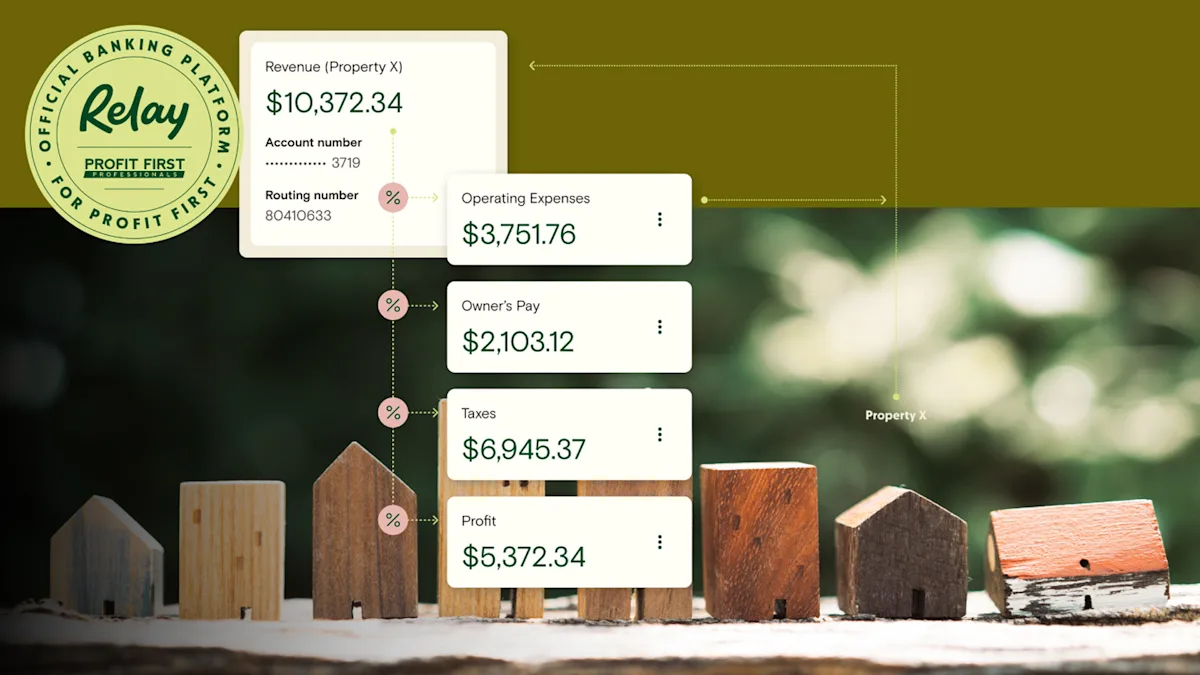
A rental portfolio can show a comfortable bank balance and still leave you short on usable cash. Rent, tax money, reserves, and contractor payments often sit in one account, and the balance no longer reflects what you can actually spend.
Profit First for real estate investing addresses that by separating rental income into dedicated accounts before any of it gets spent. Rental portfolios commit a large share of income to principal, interest, taxes, and insurance before profit, owner pay, or reserves get set aside, and routine rent collection can still leave you short when repairs, turnovers, or tax payments hit.
Why rental portfolios need a different Profit First setup
Rental portfolios need a different Profit First setup because properties carry a different cost structure than service businesses. A consulting portfolio might run leaner operating expenses. A rental portfolio with mortgages, insurance, property taxes, and homeowners association fees can commit a large share of gross rental income to PITI alone. Standard Profit First method percentages can leave too little room for maintenance reserves, vacancy coverage, or turnover costs.
Rental cash flow is also uneven by design because larger property costs rarely line up with rent collection. A major HVAC replacement does not wait for the next rent cycle, and a single big repair can consume a quarter of operating cash if it pulls from the same account that pays the mortgage.
Real Revenue in the real estate adaptation is total rental income minus PITI. That base strips out fixed obligations you cannot reduce through operating discipline and gives you a working number for allocation. You can also allocate against total rental income. Pick one base and use it across every property each quarter.
What core accounts a Profit First real estate system needs
A Profit First real estate system uses six allocation accounts plus a separate holding account for security deposits. It also needs a Repairs, Vacancy, Turnover account so repairs, vacancy coverage, and turnover costs stay separate from routine operating expenses. That split matters because a $6,500 HVAC replacement and a $180 cleaning fee do not belong in the same account.
Security deposits sit in their own account from day one. State landlord-tenant statutes commonly require landlords to hold deposits in a separate account, and commingling deposits with operating cash creates both a legal liability and an accounting problem when a tenant moves out. Check your own state's landlord-tenant statute for exact rules, since requirements around account type, in-state institutions, and tenant notice differ.
A separate deposits account also gives your CPA a cleaner handoff at quarter-end and a clearer read on net operating income (NOI) by property, because tenant funds never enter the income or operating balances in the first place.
How allocation accounts work in Profit First real estate
The allocation accounts give each type of cash a job before you spend it. The accounts separate income, profit, taxes, operating cash, and property reserves so they cannot blur into one balance.
Income: The receiving account where all rental income and online travel agency (OTA) payouts land before allocation.
Profit: Your return as the portfolio owner, distributed quarterly. This is not money for reinvestment.
Owner's Pay: Compensation for the operational work you perform, managing contractors, coordinating turnovers, and handling tenant communication.
Tax: Funds reserved for quarterly estimates, covering federal and, where applicable, state income tax obligations on rental income reported on Schedule E.
Operating Expenses: Mortgage (PITI), insurance, homeowners association fees, utilities, platform fees, and routine property management costs.
RVT (Repairs, Vacancy, Turnover): Repairs, vacancy reserves, and turnover costs. Use this account to pay for HVAC replacements, vacancy gaps, and turns instead of pulling those costs from the operating account.
Rent should land in the receiving account first, then move by rule into profit, owner's pay, tax, operating expenses, and RVT. If you spend from the same account before allocations happen, the system loses its main advantage. Relay lets you set automated transfer rules that split each deposit by percentage as soon as it arrives, so the routing happens before the balance is available to spend.
What target allocation percentages look like for rentals
Target Allocation Percentages (TAPs) shift with property type, debt load, and owner involvement. A stabilized long-term rental does not allocate like a short-term rental with weekly turns, and a mid-term furnished unit sits between the two. The tables below give specific starting percentages for each vertical. Security deposits sit outside every table. They are tenant funds, held in a separate account, never percentaged against and never commingled with operating cash.
Long-term rentals (LTR)
Long-term rentals run the leanest operating rhythm of the three: one tenant, one rent cycle, escrowed taxes and insurance in most cases, and turnover that happens every two to four years rather than every week. That stability lets you push profit toward the top of the range and hold a leaner RVT band.
Account | Allocation | Notes |
Profit | 10% | Stabilized tenants and predictable rent support the top of the range |
Owner's pay | 12% | Higher if you self-manage tenant communication and contractor coordination |
Tax | 18% | Lower if PITI escrows property taxes; raise to 20% without escrow |
RVT reserve | 5% | Raise to 8% for properties 10+ years old or with deferred maintenance |
Operating expenses | 55% | PITI, insurance, HOA, utilities, routine property management |
Short-term rentals (STR)
Short-term rentals carry the heaviest operating load and the most volatile cash flow. OTA payouts arrive on a rolling basis rather than the 1st of the month, cleaning fees recur with every turn, and seasonal refresh work concentrates in shoulder months. Target a higher RVT percentage and a lower profit percentage until cash flow stabilizes across a full season.
Account | Allocation | Notes |
Profit | 6% | Hold lower until you clear a full peak-and-shoulder cycle |
Owner's pay | 15% | Higher to reflect guest communication, turn coordination, and dynamic pricing work |
Tax | 17% | Bonus depreciation and STR active-participation treatment can pull this down |
RVT reserve | 10% | Funds frequent turns, cleaning, linens, and seasonal refresh |
Operating expenses | 52% | PITI, insurance, utilities, OTA fees, cleaner payouts, software |
Mid-term rentals (MTR)
Mid-term rentals (30 to 90 day stays for traveling nurses, relocations, insurance placements) sit between LTR and STR on operating intensity. Turns happen every one to three months rather than weekly, but the unit stays furnished and utilities stay in the owner's name.
Account | Allocation | Notes |
Profit | 8% | More predictable than STR, less stable than LTR |
Owner's pay | 13% | Reflects placement coordination and furnished-unit upkeep |
Tax | 18% | Adjust with CPA for active vs. passive classification |
RVT reserve | 7% | Funds quarterly turns, linen refresh, and furniture replacement cycles |
Operating expenses | 54% | PITI, insurance, utilities, internet, furnishing amortization |
If you consistently pull from operating expenses to cover repairs or vacancy gaps, your RVT allocation is likely too low or your base for allocation needs to change.
Worked examples by property type
LTR: $10,000 in monthly rent
On $10,000 of LTR rent landing in your income account, the split is $1,000 to profit (10%), $1,200 to owner's pay (12%), $1,800 to tax (18%), $500 to RVT (5%), and $5,500 to operating expenses (55%). The $5,500 operating bucket covers PITI, insurance, utilities, and management. When the next $6,500 HVAC bill arrives, you draw from the RVT account that has been filling on a schedule, not from the mortgage money.
STR: $15,000 in monthly OTA payouts
On $15,000 of OTA payouts landing in your income account after a peak month, the split is $900 to profit (6%), $2,250 to owner's pay (15%), $2,550 to tax (17%), $1,500 to RVT (10%), and $7,800 to operating expenses (52%). The $1,500 RVT allocation absorbs a $1,200 deep-clean and linen replacement in the shoulder month without touching the mortgage line, and the $7,800 operating bucket covers PITI, utilities, OTA commissions, and recurring cleaner payouts.
MTR: $6,000 in monthly furnished rent
On $6,000 of MTR rent from a 60-day traveling-nurse placement, the split is $480 to profit (8%), $780 to owner's pay (13%), $1,080 to tax (18%), $420 to RVT (7%), and $3,240 to operating expenses (54%). When the placement ends and you turn the unit for the next tenant, the $420 RVT allocation funds the linen refresh and minor furniture repair without disrupting the operating balance.
How to set tax and TAP rules
Tax percentages in rentals change with your portfolio structure, so revisit the number every quarter rather than setting it once. Cost segregation studies and bonus depreciation can pull the number down in a year you place new property in service. If your income is classified as passive rather than active, or if you face depreciation recapture at sale or refinance, the number can move the other direction. Have your CPA validate the tax percentage against your portfolio structure and depreciation schedule each year.
Compare what actually left the operating and RVT accounts over the quarter, check whether your tax reserves ran too high or too low, and then revise TAPs without changing the core structure.
Review cadence
Profit First's original rhythm runs on the 10th and 25th of each month. Hold the same twice-monthly cadence for rentals even though most LTR rent lands at the start of the month. On the 10th, allocate the prior cycle's rent from your income account into profit, owner's pay, tax, RVT, and operating expenses, and pay bills from operating. On the 25th, sweep any late rent or OTA payouts and pay the next round of bills. Twice a month is enough to keep the routing tight without becoming a daily chore.
How to structure Profit First accounts across multiple properties
Your portfolio size, the level of per-property visibility you need, and the number of accounts your setup can support determine the right structure.
Full separation
Use full separation if you operate a larger rental portfolio or expect a 1031 exchange soon. Each property gets its own income account and its own operating expense account, while profit, tax, and RVT accounts stay shared across the portfolio. That setup gives you cleaner per-property NOI data with less reconciliation.
Hybrid
Use a hybrid setup if you sit in the middle range. Each property gets its own income account, but the allocation accounts stay shared. For a mid-sized portfolio, that looks like separate income accounts plus shared accounts for profit, owner's pay, tax, RVT, operating expenses, and security deposits.
Shared income
Use shared income if you have a smaller portfolio and want the discipline without the account count. All rental income flows into one income account, and percentage-based transfers split it into the allocation accounts on arrival. Shared income is the easiest structure to start with, but it requires stronger review habits. Because all properties feed the same income stream, you need to watch more carefully for one unit masking another.
Choose the structure that matches your portfolio size and confirm it with your CPA. To put this structure into practice, Relay's banking page for real estate investors shows the account setup and automation built for rental portfolios.
How to transition from a single-account setup
The transition from a single operating account to a structured Profit First setup runs cleanest in four steps.
Open the new allocation accounts before changing any payment routing, so the structure exists before the first deposit hits it.
Redirect new rent and OTA payouts to the new income account on a clean cycle boundary, usually the 1st of the next month.
Run both setups in parallel for one rent cycle so anything you missed (autopay vendors, escrow drafts) surfaces in the old account without disrupting bills.
Close out the old account after a full reconciled cycle, not before.
How Profit First fits with your rental property bookkeeping
The accounts only deliver per-property visibility if your bookkeeping keeps up. In QuickBooks Online or Xero, set up a class or tracking category for each property and tag every transaction at the time of categorization. The bank structure provides the cash separation; the class tracking provides the per-property profit and loss statement. Together they let you pull NOI by property without manual sorting at quarter-end.
Relay's direct two-way sync with QuickBooks Online and Xero keeps categorization current, so your CPA can work from the same numbers you see.
What your banking platform needs to support Profit First for real estate
A banking platform for Profit First real estate needs multiple checking accounts, automated percentage-based transfers, multi-entity access, account labels, and accounting connections. Without all five, allocations stall and the method breaks down within the first month.
Relay supports up to 20 checking accounts and 2 savings accounts per business, which fits shared-income, hybrid, and most full-separation setups. Relay's automated transfer rules move a set percentage or fixed amount of each deposit into the accounts you choose, with schedule options that include per-deposit, daily, weekly, and monthly.
If you run a limited liability company (LLC) per property structure, Relay gives you one login across entities, clear account labels for a long balance list, and direct connections with QuickBooks Online and Xero so your CPA and bookkeeper work from the same data.
Set up a clearer rental cash system with Profit First
A workable Profit First rental setup starts with clear rules for your allocation base, account structure, and twice-monthly review cadence. Once those rules are in place, rent, reserves, taxes, and owner distributions each sit in a dedicated account instead of sharing one balance.
Separate rental cash so repairs, vacancy gaps, and tax payments draw from their own accounts, not the operating balance. Relay's automated transfer rules route each deposit into its dedicated account before you spend from it, so the balance reflects what is actually available. Open a Relay account to route each deposit into dedicated accounts with automatic transfer rules.
Frequently asked questions
What is Profit First for real estate investing?
Profit First for real estate investing is David Richter's adaptation of Mike Michalowicz's Profit First method for rental property portfolios, laid out in his book Profit First for Real Estate Investing. It keeps the take-profit-first idea, but adjusts the setup for properties that carry mortgage and reserve pressure that most service portfolios do not.
How many accounts do I need for Profit First real estate?
You need six allocation accounts plus a separate Security Deposits account. The total rises if you add per-property income accounts, and a hybrid setup can easily run into a dozen or more accounts for a mid-sized portfolio.
What is Real Revenue in Profit First for real estate?
Real Revenue is total rental income minus PITI. Pick one base, total rental income or Real Revenue, and stay consistent across every property.
What allocation percentages should I use for Profit First real estate?
Start with the per-property tables above: 10/12/18/5/55 for LTR, 6/15/17/10/52 for STR, and 8/13/18/7/54 for MTR (profit / owner's pay / tax / RVT / operating expenses). Then adjust based on debt load, escrow setup, and how much of the work you still handle yourself. Have your CPA validate the final percentages.
How often should I run Profit First allocations?
Twice a month, on the 10th and 25th. That cadence catches both the start-of-month LTR rent cycle and any rolling OTA payouts or late rent without becoming a daily task.
What is a strong banking platform fit for Profit First real estate?
A strong fit supports multiple checking accounts, automated percentage transfers, clear labels, and direct connections with QuickBooks Online or Xero. Keep rental income, operating cash, taxes, reserves, and tenant funds in separate accounts so each balance reflects what is available for that purpose.
BANKING FOR THE SELF-MADE
Get started in minutes.